
Knowledge Hub
Field Insights for Better Tomorrow!
A platform for all the field insights, research findings, and operational insights around wastewater engineering, pollution control, and sustainability from the Team Aapaavani!
Enter your email or download instantly.
A platform for all the field insights, research findings, and operational insights around wastewater engineering, pollution control, and sustainability from the Team Aapaavani!
FEATURED CONTENT
LATEST BLOG
Discover our latest field learnings on how new biological treatment methods are drastically reducing operational footprints and improving water recovery rates in industrial applications.
Read ArticleLATEST ON LINKEDIN
KNOWLEDGE BASE
ENGINEERING
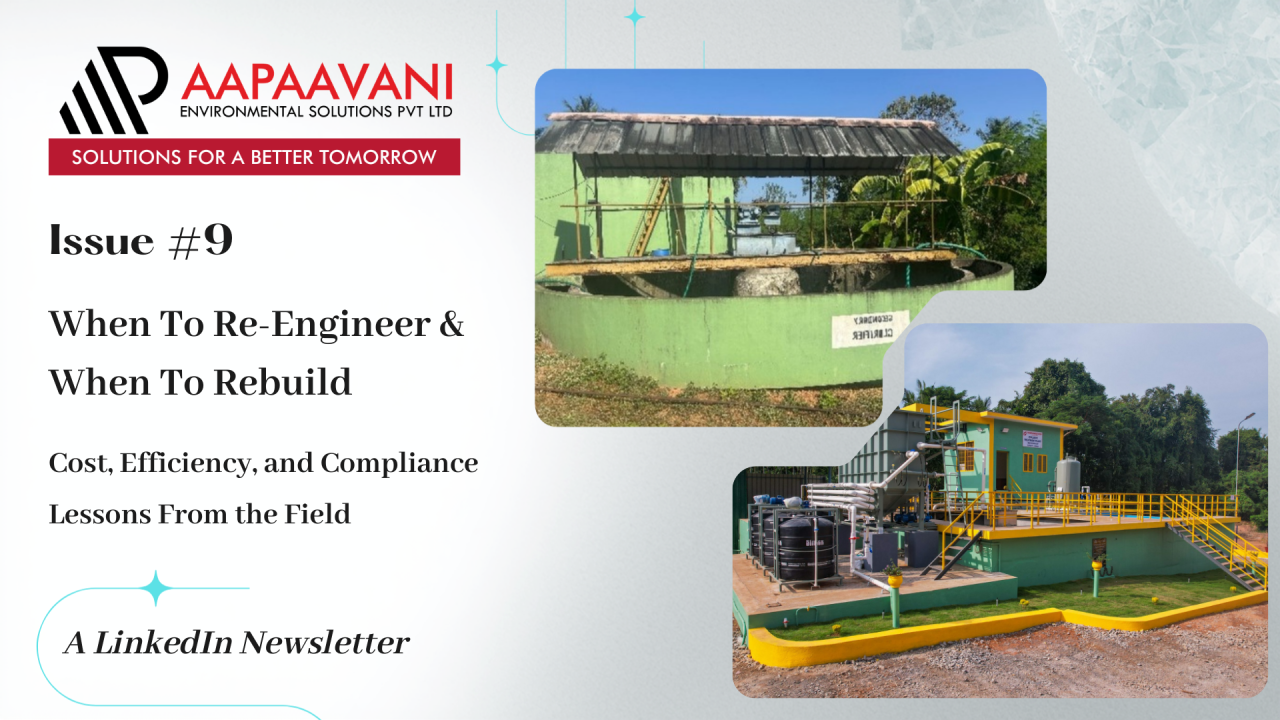
Last year, our engineers visited a food processing plant in a remote corner of western India. The management wanted us to assess their effluent and design a new treatment plant as their existing one kept failing. But Aapaavani is built differently...
Last year, our engineers visited a food processing plant in a remote corner of western India. The management wanted us to assess their effluent and design a new treatment plant as their existing one kept failing, leading to multiple show-cause notices from the SPCB. From a business angle, a new plant is always a preferred option for consultants. But Aapaavani is built differently. Our team first spent days examining the existing setup. They found something is off: the treatment train made complete sense on paper and theoretically should have worked.
In real-world scenarios, though, our design assumptions don’t always hold. Here, batches of shock loads with higher Oil & Grease content kept seeping into secondary treatment. Plus, the retention time varied significantly due to variable loads and a smaller equalisation tank. Overall, just with minimal changes in tank dimensions and some data-guided operational discipline, most issues were plugged. Then we installed a Dissolved Air Flotation (DAF) system in the primary treatment train to ensure long-term compliance without any headaches.
When we were done, the system efficiency had gone up by 60%, complying with all the regulatory norms across parameters. The management had to spend only 25% of their estimated budget for a new plant. Overall, a win-win for our stakeholders, people and the planet!
Deciding whether to refurbish an ageing or failed wastewater plant or build a new one from scratch is one of the most common questions facility owners face. The right choice balances capex, downtime, long-term operating cost, regulatory risk and the likelihood of meeting performance targets. India still treats less than 30% of its wastewater; the gap between generation and treatment makes every single plant, be it old or new, a strategic asset. Upgrading existing assets is often faster and cheaper than starting a new one, but not always the right call.
Below are pragmatic rules of thumb, evidence from the field, and lessons from real projects we’ve delivered:
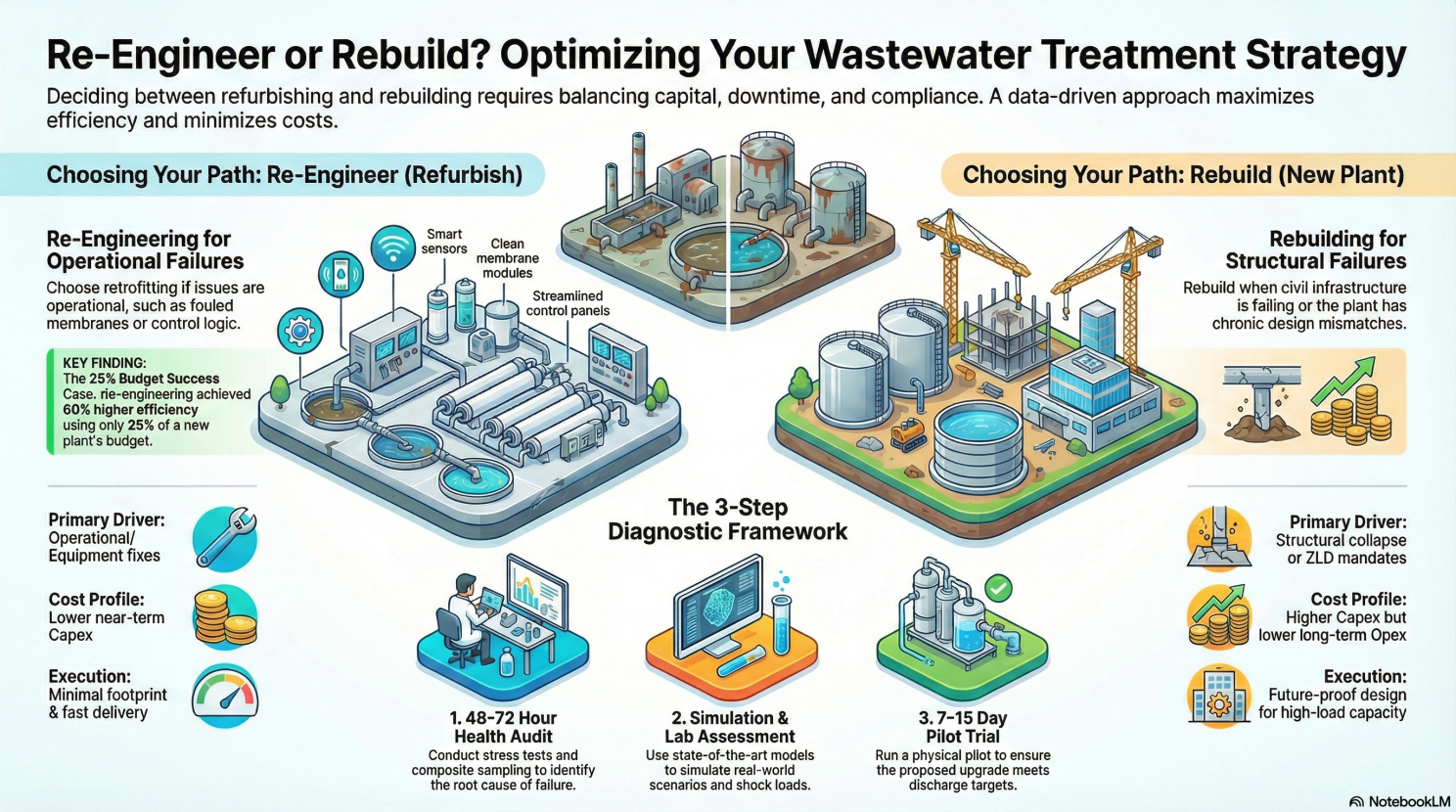
Refurbishing is an environmentally-conscious and cost-effective approach when problems are operational or equipment-level and civil structures are sound. Your goal is to improve reliability and meet consent conditions with minimal footprint and maximum efficiency. From dozens of re-engineering projects that Aapaavani has executed, we have demonstrable expertise of large cost savings, lower space footprints, and shorter execution windows.
Rebuilding is necessary when civil infrastructure is failing, or the plant suffers chronic design mismatch (undersized reactors, poor hydraulics) or if the regulatory norms mandate it. Long-term OpEx savings can be high with a modern, energy-efficient rebuild over the asset life. Our field experience shows that Aapaavani’s MBR systems, like AustenPro and EstaPro, have reduced monthly O&M costs by 40% and lowered footprint by 50%, even while achieving superior effluent quality.
We, at Aapaavani, start every assessment with a four-step audit: (1) data capture during site visit, (2) detailed laboratory assessments and simulations, (3) a pilot where possible, (4) staged techno-economic comparison (refurb vs rebuild with lifecycle OpEx). Our clients in the beverage, dairy and industrial sectors choose staged retrofits where possible; where civil replacement is unavoidable, we design for modular commissioning to protect operations during construction.
POLLUTION CONTROL
Pollutant load in our industrial effluents is often unpredictable. Therefore, most plant designers and operators rely on a slew of chemical and biological tests to determine the wastewater characteristics. However, rarely would anyone test for PFAS...
Pollutant load in our industrial effluents is often unpredictable. Therefore, most plant designers and operators rely on a slew of chemical and biological tests to determine the wastewater characteristics. However, rarely would anyone test for PFAS in wastewater, and there lies the root of a persistent, almost ‘forever’ problem.
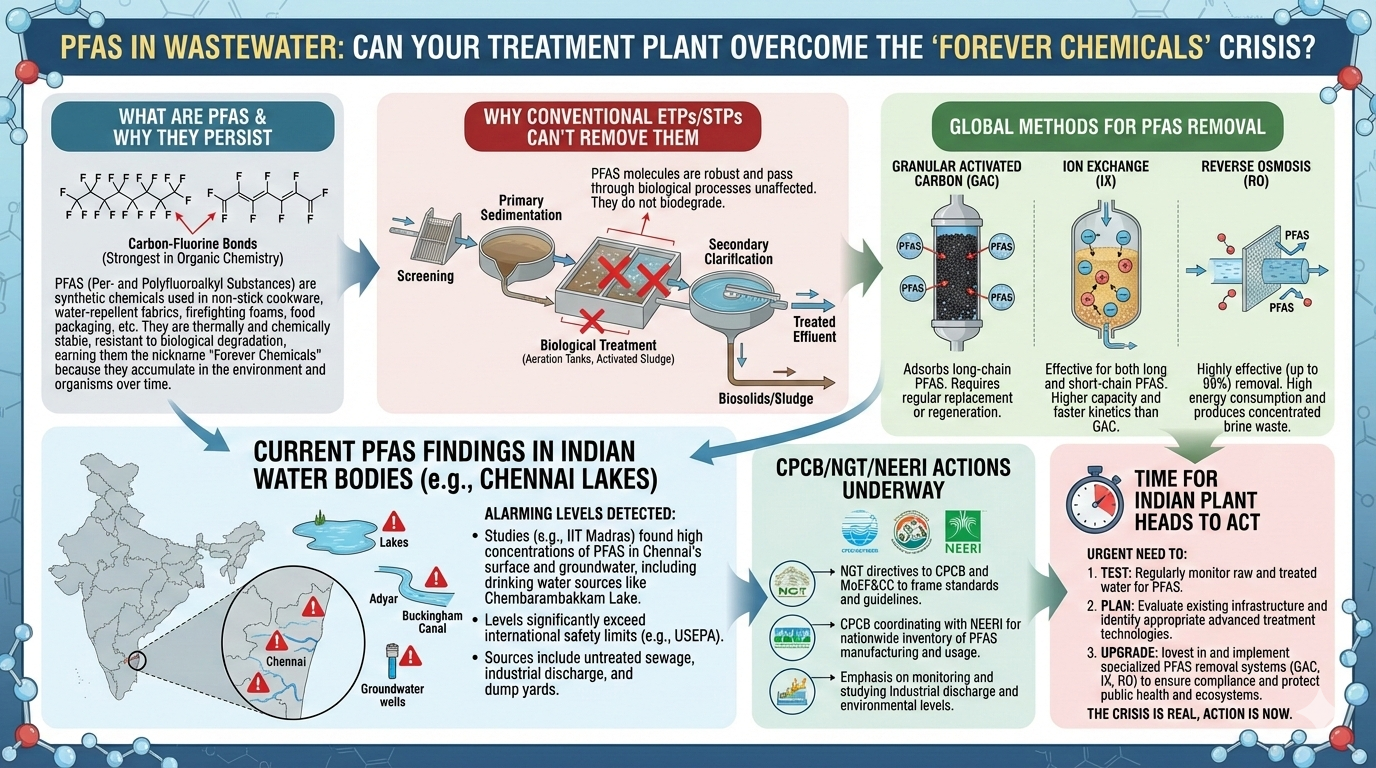
PFAS or Per- and Polyfluoroalkyl Substances refer to thousands of human-made ‘forever chemicals’ used widely in recent decades. Their water/grease-resistant properties make them ideal for daily use products like non-stick pans, waterproof clothes, cosmetics, food packaging, and several other industrial applications. These peculiar chemicals were engineered to never break down, and hence the name ‘forever chemicals’. The bad news is that they are linked to multiple severe health complications like cancer, immune problems, and thyroid disruption.
Over the past two decades, this family of synthetic chemicals has quietly infiltrated water systems across the globe. Recent research shows that most wastewater treatment plants also fail to remove them. In fact, a study by the Waterkeeper Alliance earlier this year showed that PFAS concentrations increased downstream of 95 per cent of sampled wastewater facilities across 19 U.S. states. This means these treatment plants are actively channelling contamination into rivers and aquifers instead of removing it, leading to further accumulation.
Even in India, the scenario is similar, if not worse. Researchers at IIT‑Madras recently found that PFAS concentrations in Chennai lakes are up to 19,400 times higher than safety guidelines. These alarming findings triggered a suo motu case by the National Green Tribunal, but the Chennai Metropolitan Water Supply and Sewerage Board (CMWSSB) responded that there is no mandate nor technology available to treat them.
As all of us consume water, one can easily infer that virtually everyone in the world, including Indians, now has tiny amounts in their blood. That ubiquity has regulators and water engineers on high alert. In short, India and the world are facing a PFAS wake‑up call. In April 2024, the U.S. Environmental Protection Agency (EPA) set the first-ever national, legally enforceable drinking water limits for six PFAS compounds.
India is yet to introduce effluent standards or drinking‑water standards for PFAS. But the regulations are likely to kick in soon, as the CSIR-National Environmental Engineering Research Institute (NEERI) is already surveying industries nationwide for PFAS usage. The NGT has already called on the Environment Ministry and CPCB to set formal PFAS limits in water. This decision gave rise to an estimated $50 billion in capital investment for water and wastewater treatment over the next five years. But are our treatment technologies ready to tackle these immortal chemicals yet?
In recent years, almost all streams of wastewater, be it household, hospital, commercial, or industrial, are likely to carry PFAS. Conventional treatment methods, like secondary biological processes, are designed to remove organic matter and nutrients. They fail to eliminate most chemical pollutants, including PFAS. In practice, most PFAS end up sticking to sewage sludge or passing into the clean effluent.
Proven PFAS‑removal methods include granular activated carbon (GAC), specialised ion‑exchange resins, and reverse‑osmosis or membrane filtration. GAC adsorbs PFAS molecules onto a porous surface but requires regular regeneration and creates a waste stream that must be handled carefully. Ion-exchange resins perform better than GAC for certain PFAS compounds, particularly shorter-chain variants, with some advanced proprietary resins showing removal rates 6-8 times better than traditional carbon filtration. High-pressure membrane systems like nanofiltration and reverse osmosis can achieve removal rates exceeding 90 per cent, including for short-chain PFAS that are harder to capture. However, they remain relatively expensive.
Other experimental ideas like ultraviolet oxidation, electrochemical “split” of molecules, and even incinerating PFAS‑containing sludges exist only in experimental or pilot stages. Even though they show promise, such solutions require huge capital investment, operational expertise, and integration into your existing treatment train. One-size-fits-all approaches don't work here. You need systems tailored to your influent characteristics, budget, discharge limits, and operational capacity.
For plant managers and facility heads, the question is no longer whether to address PFAS, but when and how. Right now, it’s a personal responsibility towards public health, but soon it’ll be a compliance challenge. A proactive approach involves a comprehensive assessment of your influent and available processes. It means evaluating treatment upgrades now rather than scrambling under regulatory deadlines. The ‘forever chemicals’ crisis is a reminder that the pollution problem will continue to get more complex and won't disappear on its own. But with the right engineering, technology, and planning, it can be managed.
SUSTAINABILITY
For every small question that crosses our mind, or almost every other sentence we write online, we’re becoming increasingly dependent on AI tools like ChatGPT. But, did you know, for every AI prompt, a few milliliters of water disappear?
For every small question that crosses our mind, or almost every other sentence we write online, we’re becoming increasingly dependent on AI tools like ChatGPT. But, did you know, for every AI prompt, a few milliliters of water disappear. So, imagine how much water we need for billions of queries and tasks across thousands of AI tools daily. Add that to the possibility of exponential growth in both the number of people and the use cases for AI tools in the coming years.
This does not mean we have to (or can) minimise the use of AI in any way. But we can definitely manage our precious water resources more efficiently.
Training GPT-3 alone consumed 700,000 litres of freshwater, enough to manufacture 370 BMW cars. Subsequent upgrades are said to be even more energy- and water-intensive. According to a recent report by Morgan Stanley, AI data centres are estimated to drive water consumption to 1,068 billion litres annually by 2028, more than 10 times their current usage.
That is not a typo!
Cooling towers across an increasing number of data centres worldwide convert water into steam to keep servers cool and functional. The machines powering our digital lives are drinking us dry. For India, a country with 18 per cent of the world's population but only 4 per cent of its freshwater resources, we need to find incredibly innovative ways to stay competitive.
Delay carries consequences. Globally, regions facing water stress, like Singapore and Canada’s Bow River Basin, have imposed a temporary ban on data centres. But India needs more data centres, and we cannot allow resource constraints to slow our pace towards digital autonomy.
India's data centre market is exploding. Bengaluru alone is projected to double its IT capacity from 203 megawatts in 2025 to 398 megawatts by 2031. Mumbai, Chennai, Hyderabad, Ahmedabad, Pune, Mysore, and Delhi are following suit, hoping to place India at the centre of the global digital hub. The Indian government's Digital India vision, combined with 5G rollout and cloud adoption, is driving investments worth billions.
Yet beneath this digital gold rush lies a resource quietly being depleted: water. Most discussions focus on megawatts and server density. Few ask where the water will come from.
A single 1-megawatt facility consumes up to 25.5 million litres of water annually just for cooling. A 100-megawatt hyperscale centre can demand 730 million litres per year, equivalent to the needs of roughly 15,000 people. Emerging AI workloads could amplify this dramatically.
India already faces acute water stress. By 2030, parts of 21 cities, including Delhi, Bengaluru, Chennai, and Hyderabad, face the risk of running out of groundwater. Bengaluru, the data center capital, has been experiencing a recurring water crisis almost every summer in recent years. In 2024, the city faced a 500 million litre per day shortage. This can lead to a conflict between social and economic interests. Communities in Uruguay, Chile, and the Netherlands have protested data center projects over water concerns.
India’s economy cannot afford to let datacentres go by. Only about 20% of India’s digital data is stored domestically, meaning roughly 80% flows through foreign servers. With the boom of AI and digital tools in the US and China, India risks falling behind if it fails to invest in developing the right infrastructure (read datacentres). Investment can’t be only in terms of capital. It should also be about ensuring a sustained water supply through efficient treatment and recycling.
The good news? Solutions exist. Sustainable data centre solutions are on the rise. Operators are increasingly adopting water-efficient technologies. Air-cooled chillers eliminate water consumption entirely. Microsoft announced zero-water evaporation designs for new datacentres, using closed-loop liquid cooling systems that recycle water without a fresh supply.
India's data centre cooling market is projected to reach USD 7.68 billion by 2030, with liquid solutions growing at 27.7 per cent annually. That’s an immense growth potential, unlike most sectors in the modern economy. Along with power and connectivity, operators are now evaluating locations based on water availability as well. Karnataka and Maharashtra policies now promote rainwater harvesting, greywater reuse, and treated sewage water for cooling.
POLICY
Every day, 72 billion liters of domestic and 13 billion liters of industrial wastewater flow out into the drains. The new Liquid Waste Management Rules, 2024, are officially effective from October 1, 2025, and are set to transform the sector.
Every day, 72 billion liters of domestic and 13 billion liters of industrial wastewater flow out into the drains (Niti Aayog, 2022; MoEFCC, 2024). How much of it is treated? As per official estimates, less than 30% domestic sewage and less than 60% industrial effluent is treated. The ground reality is likely even worse.
The rest? This highly polluted and toxic liquid waste enters our rivers, lakes, soil, and groundwater.
A 50-year-old legislature, The Water Act of 1974 has governed this extremely important domain thus far. And it has done a fairly good job at that, though the on-ground implementation remains patchy.
Last week, a new, revolutionary act came into force. And it could change how we look at wastewater forever: from a crisis to an opportunity. The Liquid Waste Management Rules, 2024, are officially effective from October 1, 2025, and are set to transform the wastewater treatment sector into a goldmine of innovation and action.
India's current wastewater treatment efficiency is dismal. Despite having thousands of sewage and effluent treatment plants, we barely treat 30% of the wastewater. It’s not just a health and environmental hazard, but also an economic wastage as we drain resources worth billions without even an attempt to recover.
This treatment gap has created an urgent need for decentralized treatment systems and innovative wastewater reuse strategies. And that’s exactly what the new regulations mandate.
The Liquid Waste Management Rules, 2024, represent India's boldest shift from a "flush and forget" mentality to Extended User Responsibility (EUR). Every entity consuming more than 5,000 liters daily must now treat and reuse their wastewater: 20% by 2027-28, escalating to 50% by 2030-31.
This regulatory earthquake affects almost everyone, including industries, apartment complexes, hospitals, and educational institutions nationwide. The message is clear: own your waste, treat your water, and contribute to India's circular water economy.
The comprehensive framework introduces universal coverage from metropolitan cities to rural villages, with phased implementation timelines. Cities with a population of over one million must comply immediately, while smaller towns have until 2030.
The rules establish a centralized digital platform for registration, monitoring, and trading of EUR certificates, creating transparency in India's wastewater reuse ecosystem.
If you are wondering how it impacts you or your organisation, here’s a quick compliance roadmap:
Pro Tip: Don't wait until the authorities come knocking. Early adopters will secure better pricing and reduce the compliance cost.
The wastewater crisis is not just about treatment plants. Space constraints in urban areas, initial investment requirements, and technical expertise gaps also present immediate challenges.
However, a scientific approach can overcome these challenges if all stakeholders continue to innovate. Modular systems, phased implementation approaches, and public-private partnerships are some of the systemic approaches towards a solution. Decentralized treatment systems offer particular promise, requiring CapEx of just Rs 4,000-6,000 per capita.
The resource recovery from wastewater opportunity includes biogas generation, nutrient extraction, and thermal energy capture, transforming treatment costs into revenue streams.
Did you know? India's wastewater sector, valued at $12.1 billion in 2024, is projected to grow at a 16.7% CAGR and reach $40.9 billion by 2032. The broader circular water economy presents even greater opportunities.
The consulting sector faces unprecedented demand for compliance planning, system design, and regulatory navigation services. Tie-up with expert wastewater treatment solution providers like Aapaavani could help ease this transition.
The opportunity window narrows with each passing month. Organizations must assess current water usage, evaluate treatment options, and develop comprehensive compliance roadmaps. Whether you're managing a residential society, industrial facility, or commercial establishment, professional guidance ensures optimal compliance strategies tailored to your specific requirements. We, at Aapaavani, are confident that this regulatory shift from drain to resource recovery marks India's transition toward a sustainable economic superpower.
INDUSTRIAL WASTEWATER
Wastewater can be oddly human. Some streams are calm and predictable. Others are aggressive and full of surprises. And a few are deceptively quiet until they suddenly turn into volatile troublemakers...
Wastewater can be oddly human. Some streams are calm and predictable. Others are aggressive and full of surprises. And a few are deceptively quiet until they suddenly turn into volatile troublemakers.
Take, for example, this case where a plant that was running smoothly for five years suddenly started misbehaving. The secondary clarifier defied gravity, like a villain who had just been punched by our Sandalwood hero, foaming all over and acting like a Dissolved Gas Floatation unit (DGF).
Or in this wild case, where a treatment plant designed based on “lying effluents” (polished lab samples), failed soon after commissioning. In another case that we reviewed recently, the plant parameters shifted eight months into operation, with excessive foam in the aeration tank and trace ammonia in the treated water.
Side note: It’s been a while since our first four editions. For nearly seven years, Aapaavani has been building wastewater treatment solutions, picking up lessons, overcoming unique challenges, and gathering insights worth sharing. In engineering, keeping things under wraps is a recipe for disaster; sharing knowledge sparks dialogue and learning. Subscribe and comment as we grow a community of like-minded professionals.
Let’s dive back into our story about lying effluents. In the world of industrial effluent, trouble is not a plot twist but a daily reality. And more often than not, the culprit is not a flawed design or an overworked operator, but the fickle nature of the effluent that tells you one thing today and another tomorrow.
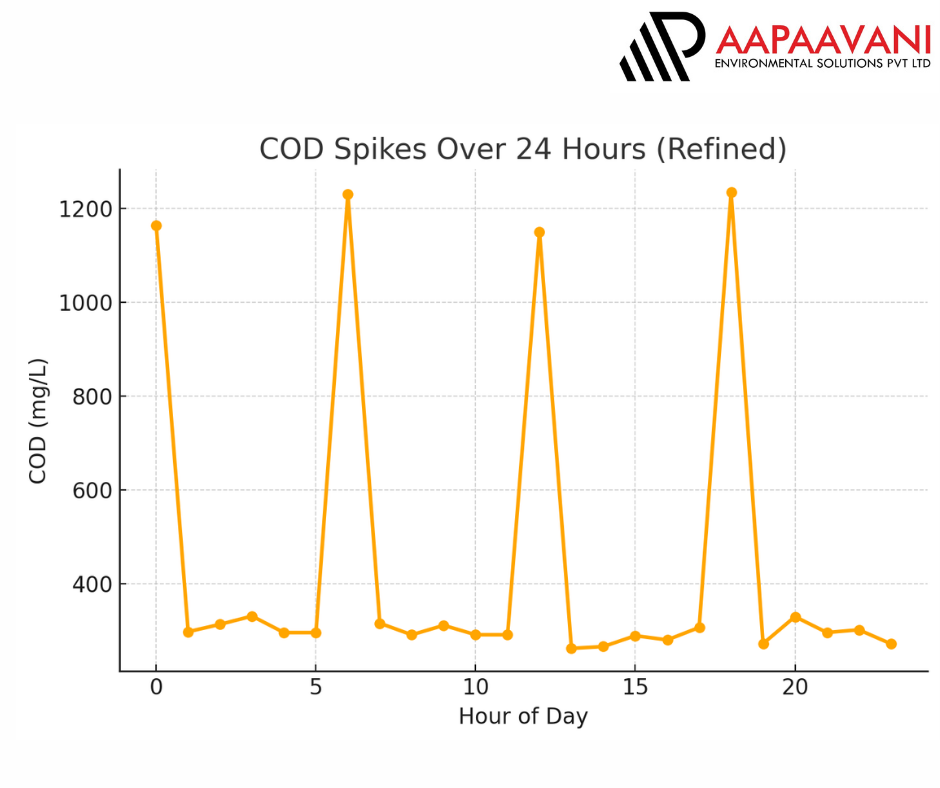
To start with, your influent itself can change with the shift of a valve, a small change in product line, or a cleaning cycle. We’ve seen this firsthand. Here’s an example. In a chocolate factory, wastewater appears polite and harmless during sampling. Yet, once batch washing begins, sharp spikes in chemical oxygen demand (COD), fats, oils, and grease transform it into an unmanageable mess.
Industrial effluents lie. They pretend to be stable. They give you a polished sample. But the moment your treatment plant is commissioned, they show their true colors. Unstable effluents are not just an operational challenge; they carry wider social and environmental risks. Even one large batch of poorly treated effluent can contaminate rivers for months, disrupt ecosystems, and undermine compliance, affecting the long-term reputation of the firm.
Conventional treatment systems are built for predictability. They thrive when loads are consistent and inputs remain steady. But industries don’t work like that. In manufacturing:
Technologies like activated sludge processes (ASP) or basic sequencing batch reactors (SBRs) are not equipped to handle such variation.
For such deceptive effluents, Membrane Bio Reactors (MBRs) stand out because they manage the unpredictability with finesse. Unlike rigid systems, they adapt to fluctuations, isolate problematic loads, and consistently produce high-quality treated water. MBR isn’t just another treatment tech. It’s the effluent whisperer.
But, there’s a catch. MBRs are powerful, yes, but not foolproof. They need a careful listener, a thoughtful designer, and a proven caretaker. Effective deployment involves studying the “mood swings” of an industry’s wastewater before finalising the setup. Selling MBRs as ready-made solutions risks failure; tailoring them through data-driven design ensures success.
Because in the world of industrial treatment, there’s no one-size-fits-all. So, the next time someone asks, “What’s the best treatment technology?”, ask back: “Tell us about your effluent’s personality.” Because that’s where true treatment begins. Not with a product brochure, but with an honest diagnosis of your effluent’s behavioral patterns. And for the effluents that lie, manipulate, and explode when you least expect it, Aapaavani is the one friend that doesn’t leave your side.
ENVIRONMENTAL FORENSICS
When you visit a doctor, he looks for visible symptoms, reviews your medical history, and might ask for blood tests. Now, imagine you’re the doctor, but instead of a single patient, you’re diagnosing an entire city. Where would you start?
When you visit a doctor, how does he figure out what’s wrong? He looks for visible symptoms, reviews your medical history, and might ask for blood tests. Now, imagine you’re the doctor, but instead of a single patient, you’re diagnosing an entire city. Where would you start?
Wastewater, of course! Sounds odd? Stay with us.
In the busy modern world, wastewater has long been neglected as a mere byproduct of human activity and swiftly flushed away through a large network of sewers. Yet, beneath this veil of obscurity lies a treasure of information, offering profound insights into public health trends, environmental pollutants, and the clandestine activities of industries.
This emerging field of study, known as environmental forensics, is transforming our understanding of wastewater from waste to a vital diagnostic tool.
Remember the COVID-19 pandemic? The collective trauma of millions of lost lives and the economic hardships may never fade. But the world also witnessed exemplary progress in scientific research during those tough times. The pandemic also turned the spotlight on the pivotal role of wastewater surveillance in tracking disease prevalence within communities.
Health officials of multiple cities around the globe used genetic markers of pathogens in sewage to determine the prevalence of COVID-19 among the city populace, even as the majority of the cases went undetected due to asymptomatic cases. While these tools were extensively deployed during the recent pandemic, the concept of environmental and wastewater forensics has been around at least since the 1980s.
Now, health officials use wastewater to gauge infection rates, often identifying outbreaks even before they manifest clinically. This proactive approach enables timely interventions, potentially curbing the spread of diseases. The US Center for Disease Control and Prevention (CDC) also talks about how monitoring wastewater can help find infectious diseases like influenza and SARS-CoV-2 variants early.
Recent studies have gone one step further to expand the horizons of wastewater surveillance. A study that came out last month in Nature Medicine showed that looking at the sewage from planes at international airports could find new pandemics up to two months before other methods. The study showed that by monitoring wastewater from 20 key airports, scientists can effectively map the global movement of pathogens.
Imagine if such a superpower were available just a few years ago; how different the COVID-19 propagation would have transpired around the world!
The versatility of wastewater analysis extends to monitoring foodborne pathogens as well. Researchers at Pennsylvania State University collected raw sewage samples from treatment plants and found not one or two, but 43 distinct Salmonella isolates. The study underscores the potential of wastewater surveillance in providing early warnings for foodborne disease outbreaks, thereby safeguarding public health.
Beyond public health, wastewater also serves as a mirror reflecting the environmental practices of industries. Environmental forensics employs chemical, physical, and statistical analyses to trace contaminants back to their sources, holding polluters accountable. This discipline has been instrumental in identifying the origins of pollutants like per- and polyfluoroalkyl substances (PFAS), commonly known as "forever chemicals," notorious for their persistence and adverse health effects.
The recent scientific advances highlight the importance of integrating wastewater surveillance into public health infrastructure for early detection of disease outbreaks. Employing sophisticated methods, such as mass spectrometry and genomic sequencing, enhances the accuracy and scope of contaminant detection, bolstering environmental forensics capabilities. Implementing stringent regulations based on wastewater data can deter industrial pollution and promote environmental stewardship.
Wastewater, often dismissed as useless, is increasingly seen as a resource that can boost the circular economy of the future. In addition to being a source of nutrients, power, and fuel, it can now act as the bookkeeper for an entire community if utilised well. With the power of environmental forensics, wastewater surveillance empowers us to anticipate public health challenges, trace environmental contaminants, and hold polluters accountable.
Let’s listen to the stories whispered by our wastewater and act decisively for a healthier, more sustainable future.
RESOURCE RECOVERY
What if I told you that nearly half the water we use at home doesn’t need to be flushed away into sewage drains? Every time you shower, wash your hands, or do the laundry, you’re generating something we call ‘greywater’.
What if I told you that nearly half the water we use at home doesn’t need to be flushed away into sewage drains? Every time you shower, wash your hands, or do the laundry, you’re generating something that we engineers fondly call ‘greywater’.
Greywater is a form of wastewater that’s slightly dirty but reusable. Think of it as yesterday’s rice; it’s still good if used wisely, but we throw it away without a second thought. It makes up a whopping 50–80% of household wastewater, yet in almost every Indian city, it’s flushed away, mixed with sewage, and lost for good.
Here’s the shocking part: India is on track to face severe water shortages by 2030, with demand expected to be twice the available supply, as per the NITI Aayog’s projections. Meanwhile, millions of liters of potentially recycled greywater flow into sewers, or worse, go untreated into water bodies, disrupting the entire aquatic ecosystem.
If we’re serious about tackling water scarcity, we can’t afford to ignore greywater reuse anymore.
Most of us assume that all wastewater is the same. It’s not. But here’s the problem: Cities across India, even across the Global South, treat both the same way, by mixing them together. That’s like washing or throwing away your entire wardrobe because a few clothes got dirty. Makes no sense, right?
Every engineering student learns early on that each problem requires a targeted solution. Mixing two separate problems is like trying to address a software bug with a hammer; it’s messy, wasteful, and bound to fail. Yet, despite over a century of engineering progress, most municipal departments—not just in India, but globally—still treat wastewater and sewage like a one-size-fits-all problem.
Now, some of the advanced economies are waking up to greywater’s potential globally. Singapore, Israel, and parts of the US have integrated greywater reuse into their water management systems. But in India? Decentralized greywater treatment remains severely underutilized despite its massive potential.
With rapid urbanization, our centralized sewage treatment plants (STPs) are overburdened and inefficient. As per the Central Pollution Control Board of India (CPCB), most centralized plants treat only 30–40% of generated sewage. The rest goes untreated into rivers, lakes, or groundwater, contaminating the ecosystem and threatening public health.
Many housing societies and apartment complexes treat drains like a black hole, dump anything and forget. Untreated greywater flows straight into the sewage drain like an uninvited guest at a wedding feast. Meanwhile, most Indian households (except for a few fancy new apartments) have zero systems to capture and reuse greywater.
The irony? A little effort, like filtering and reusing greywater for gardening, car washing, or flushing, could save thousands of liters per family every year. But hey, who needs water when you can pay for tankers, right? Cities like Bengaluru and Chennai grapple with extreme water shortages and depleting groundwater every single summer.
As water sources dry up, the cost of freshwater skyrockets, pushing it out of reach for vulnerable communities. Imagine not being able to cook, bathe, or even drink water simply because you couldn’t afford it. Isn’t that a violation of a basic human right?
For most cities in India, fixing the crisis does not require large-scale infrastructure fixes. We can treat greywater where it originates, in homes, apartments, and commercial buildings, thanks to an approach called decentralized treatment systems. Here’s why this approach makes sense:
Globally, 50% of treated greywater is reused in developed nations, but India barely scratches the surface.
To promote decentralized treatment plants in India, citizens and policymakers need to come together to implement the following measures:
India can no longer rely solely on rain and groundwater. If we want to secure our water future, greywater reuse must become mainstream in homes, industries, and urban planning.
DOMESTIC SEWAGE
Ever wonder what happens after you hit ‘flush’? Most of us don’t give a second thought to where our household sewage flows. It disappears down the drain, and we assume it’s "taken care of". Let's break down its complex journey.
Ever wonder what happens after you hit ‘flush’? Most of us don’t give a second thought to where our household sewage flows. It disappears down the drain, and we assume it’s "taken care of" (unless it starts leaking into your apartment basement and the irritated society uncle comes and shouts at you!).
But wastewater isn’t just magically returned to nature; it takes a complex journey, and depending on where you live, that journey may not be as smooth and efficient as one might imagine.
Let’s break it down: from your home, through treatment (or not), and back into the environment.
Every time you wash your hands, take a shower, or flush the toilet, that water becomes domestic wastewater. It carries soap, shampoo, food particles, grease, and—let’s be real—some things that were never meant to be flushed (yes, those wipes, oils, and napkins should never be flushed, no matter what their packaging may claim).
As this wastewater enters your home’s drainage system, water from your kitchen, bathroom, and laundry mixes before making its way to the next stage. But here’s the twist: not all wastewater takes the same journey. Some lucky homes are connected to sewage treatment plants (STPs).
Others, especially in remote or rural areas, rely on septic tanks or see their wastewater discharged directly into nearby water bodies with little to no treatment. So what happens next?
For those connected to an STP, wastewater goes through several levels of treatment:
To understand these steps and processes in simple terms, our CTO Vishnu Sharma explains them by using an apt analogy of human anatomy; don’t miss it!
While all this sounds great, STPs aren’t invincible. Most municipal treatment plants were designed decades ago to handle only the biodegradable wastes. But in the 21st century, household wastewater is turning into a chemical cocktail of cleaners, synthetic personal care products, and oils that clog pipes and disrupt the microbial balance. Such effluents rarely get efficiently treated, and end up causing further pollution.
And what about areas without proper wastewater treatment? A shocking amount of wastewater—especially in urban informal settlements, small towns, and villages—flows untreated into lakes, rivers, and oceans. This means raw sewage, rich in pathogens and pollutants, ends up contaminating natural water sources, harming aquatic life, and creating health hazards for local communities.
If wastewater is properly treated, it can be safely discharged into rivers and lakes, or even reused. In places like Singapore, treated wastewater (NEWater) is purified to a level that it is safe to drink. Some industries also reuse treated water for cooling systems, while others use it for irrigation.
But when wastewater isn’t treated? That’s where things get messy.
So, what can we do to improve domestic wastewater management?
The journey or wastewater doesn’t end when it disappears down the drain—it’s just beginning. And how we handle it determines the health of our planet. Let’s stop flushing away opportunities for a cleaner, more sustainable world.
INNOVATION
Why is wastewater treatment considered the most underrated aspect of sustainability? Despite being one of the oldest aspects of environmental sustainability, we need to rethink our approach to sewage in terms of the circular economy.
Let's start with the big picture. Why is wastewater treatment considered the most underrated aspect of sustainability?
Despite being one of the oldest aspects of environmental sustainability—India passed the Water Act in 1974—wastewater treatment appears to have received less mainstream coverage. Only when visible foaming occurs in lakes in Bengaluru or rivers in North India does this topic garner headlines. But isn't it a shame if we talk about basic pollution and bare minimum treatment even after more than half a century of regulation and innovation?
We need to rethink our approach to sewage and effluent treatment now in terms of the circular economy. But on-ground awareness takes time to build. For instance, how many of us realise that the water we flush could be used to extract fuel? Intrigued? Let's dive in!
Traditionally, people just wanted to wash their hands off (pun intended!) in terms of wastewater disposal. It was viewed as a compliance burden and nothing more. However, modern science tells a different story. We can now harness wastewater to address multiple sustainability challenges. The world is gradually waking up to the potential of wastewater as a source of energy, food, and minerals, and, crucially, as a solution to the world's increasing water scarcity issues.
Wastewater treatment plants (WWTPs) are now evolving into energy hubs, where biogas extracted from sewage can power homes and industries. Advanced technologies such as anaerobic digestion enable plants to convert organic waste into methane, a renewable energy source. What's more, the use of treated water for irrigation and industrial processes also alleviates pressure on freshwater sources.
We are sitting on a once-in-a-generation opportunity to revolutionize sustainability, benefitting industries, communities, and ecosystems. The wastewater treatment landscape has undergone a dramatic transformation. Modern techniques have not only improved efficiency but also opened new avenues for resource recovery. Here are a few examples: Watch Video →
The benefits of these and many other evolving wastewater treatment methods transcend beyond the mere reduction of environmental pollution. They help lower carbon footprints, save costs for industries and other stakeholders, empower communities, provide alternative solutions, and create jobs.
Despite all the good stuff we discussed so far, why does wastewater remain an underexplored opportunity? For one, high capital expenditure! Advanced and modern treatment systems require significant investment, which can deter adoption. Then there's a public perception challenge, with most people being hesitant about using treated wastewater. Lack of awareness and skills among many industries and municipalities, especially about the latest technologies and their benefits, remains a major bottleneck.
To unlock the full potential of wastewater, collaboration among governments, industries, and communities is essential. Larger investments in research and development, raising awareness, strengthening policies, and adopting circular economies are the needs of the hour.
The question is no longer, “What can we do with wastewater?” but rather, “How can we unlock its hidden potential?”
R&D AND PUBLICATIONS
Research is the lifeline of our work. Our R&D Division Head, Dr. Adithya Samanth, recently published a paper in the South African Journal of Chemical Engineering offering fresh insights into herbicide adsorption. Furthermore, our Co-founder Dr. Vishnu Sharma co-authored a review in the Microchemical Journal on emerging lab-on-paper pesticide detection techniques for rapid field testing.
Identify hidden inefficiencies and take the first step towards strict compliance and long-term cost savings for your plant.
Download PDF
